Geography-Geological Department of
the Tbilisi State University
Vakhushti Bagrationi Institute of
geography of Georgian Academy of Sciences
THE INTERNATIONAL ELECTRONIC CONFERENCE

NATURAL POTENTIAL OF THE MOUNTAINOUS
TERRITORIES: SITUATION, PROBLEMS, PROSPECTS
Internet/E-mail discussion 25.05 – 25.07.2003

current status of arkhar population (Ovis ammon l.) in central tien-shan (
M-R. D. Magomedov*,
E. G. Akhmedov*, W. A. Wall**, A. E. Subbotin***
* - Caspian Institute of Biological
Resources (PIBR DNC RAN), 45 M-Gadgieva str.,
Daghestan, Russia, Catholic University
of Lublin,
** - Safari Club International Foundation
*** - A.N.Severtzov Institute of
Moskow 117071, [email protected]
All field data was collected in November - October 2002 in the Eastern
Part of Central Tien-Shan (main camp - 78017/ e.l., 41036/
n.l., at the elevation of 3350 m a.s.l.) at the upper part of Baralbas river (Fig.1).
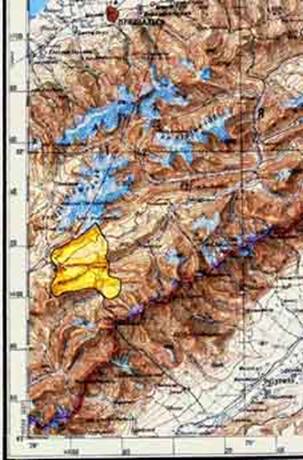
Fig. 1. Region under study (yellow)
in the Eastern Part
of
Central Tien-Shan
The
territory of investigations is situated between 3300 and 4500 m a.s.l. Relief
is characterized by stretched in tens and hundreds kilometers mountain ridges
in sublatitudial direction, closed by intermountain us
depressions (Pig.2). The average annual temperature is negative. The average
July temperature does not exceed 100. Nowadays the investigated
territory practically is not used for livestock pasturing. Poaching is taking
place sporadically but significantly reduced by anti-poaching control.
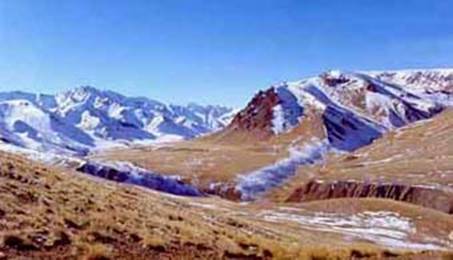
Fig. 2. Territory is a rocky area with relatively gentle
slopes and narrow valleys.
The
object of investigations - Ovis ammon
sp. L., without clear taxonomic status, which has to
be determined (Pig. 3).
Field surveys were undertaken on 8 censured transects with a total length of 190 km. The transects were drawn beforehand as well as censuses
areas were laid in 3-5 km each. The total
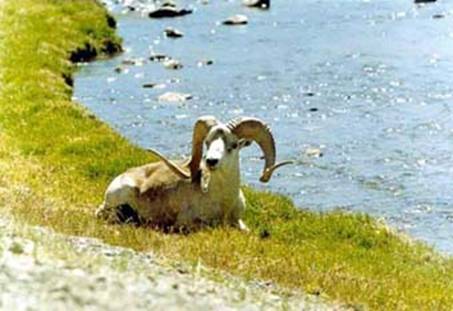
Figure 3. Ovis ammon sp. L.
number of visually
determined arkhars was 717 animals, which of 94 animals were met twice. So for
the estimation of real population density we used data for 623 individuals. The
total square of the investigated area was 586 km2.
We have chosen 4 sex-age
classes of animals: adult females, adult males, juveniles and yearlings. The
age of adult males was determined with the accuracy of 1 year. We also used the
horns of dead animals of found 37 sculls of males and 2 sculls of females at
the age from
Results. The average density of arkhars at the period of the fieldwork was
estimated of 1,1 individual per 1 km2. 58 groups of arkhars were totally found. The
sex-age ratio was estimated for 49 groups.
For 544
animals of 623 met in the field the sex-age status was exposed, shown that in
the population inhabited the Akshiyrak river-head the adult females predominate
(42,3%). The portion of adult males (> 2 years) and
yearlings was respectively 22,2% and 22, 1%. The
lowest portion fell on the juveniles - 13,4% (tabl.1)
The sex ratio among the animals of 2 years and elder scored 1,9:1,0 in favor of
females. The number of juveniles per female is about 0,5.
Using the meanings of age distribution of males
and their portion in the population, the meanings of each age group of females
and males were estimated for the whole population. The total demographic
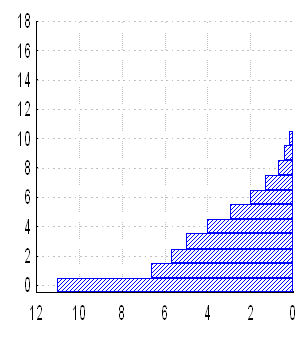
structure and age pyramid of the investigated population is shown, wherefrom we
can consider that the portion of males in the population begin to decrease
significantly from the age of 4 and that they disappear totally after the age
of 10(Fig. 4) The key factors, determining the sex-age structure of arkhar
population are shown up.
The minimum of arkhars was met on the Eastern and Western slopes, 10,4% and 11,6%, respectively. More than a half of the animals
were met on the Northern slopes - 58,2%, and 19,8% -
on the Southern slopes although this time they were totally free of snow. This
arkhar distribution depends mainly on plant distribution, characterized by high
projective cover (70-80%) and most valuable plants (in terms of forage quality)
on the Northern slopes.