Catalogue of Unusual Phenomena in the Solar
Radio Emission at 210MHz Frequency within 1957-1967
Sh.S.Makandarashvili
Investigation
of the solar radio emission makes valuable contribution to the matter of
understanding physical processes occurring in the solar atmosphere. They make
it possible to study the processes
taking place at various levels of the solar atmosphere. They provide some
information on the medium at the heights beyond the direct optical radiation.
This is particularly specific to the 210 MHz emission band occurring at 0.3-1.0
R¤ above the photosphere.
The
solar radio emission consists of a thermal background and various bursts of
sporadic radio radiation, sometimes very intense. They are usually localized in
active regions of the solar disc. Bursts are considered to be a basic
characteristic of the solar activity, and therefore a significant object of
investigation.
Radioastronomic
methods of observation largely supplement the results of optical investigations
and in some occasions they are the only method of obtaining information on
physical conditions of generation and on the way of propagation of radio
waves. Investigations of the solar radio
emission enable one to find out its relation to dynamical processes in the
solar atmosphere and to various geophysical phenomena. The comparison of
results obtained due to observations in different spectral regions of the solar
radiation, is an important method of studying different events occurring in the
solar atmosphere. In the visible region where the Sun emits most of its energy,
time variation of total radiation is very poor. The radio emission varies
significantly: slow variations of the radio emission level and fast outbursts
are superimposed on the weak constant radiation (constant component). Their
intensity in the metre wave band can exceed the emission of the quiescent Sun
by a few thousand times. Our knowledge
of the solar activity has been essentially enlarged due to development and
coordination of optical and radio observations.
Recently
measurements of the solar radio emission provided a lot of information
concerning the solar corona. The radio observations have the advantage of
permitting to attain a high resolution for the heights in the corona as the
velocity of propagation of radio waves distinctly depends on the medium
density. Great heights, where the metre wave emission arrives from, point to
the distance from the Sun, at which the solar corona can be studied by radio
methods. At present there is a possibility of continuous observations of the
solar corona and accordingly,
registering of the flux radio emission and bursts. Thus, radio astronomy
and optical one supplement each other.
At
present radio emission of the metric wave band is divided into five types
according to spectral properties. radio emission of noise storms belongs to the
first type. It involves irregular increase of the emission with numerous
intensity peaks following one another, the lifetime of which is ten fractions
of a second.
Noise
storms, the first type solar radio emission, were registered on the Earth by
J.S. Hey in 1942. Nowadays there exists a considerable amount of observational
data giving possibility to study certain properties of the solar activity
effect. The noise storm bursts are observed earlier and disappear 1-2 days
later than the enhanced background radiation.
It is
established that the noise storms are connected with large groups of spots in
the photosphere, particularly with those in the central part of the solar disc.
Probability of the radio emission emergence increases with the area of the
whole group as well as with that of the largest spot. Both the bursts and the
background radiation have a high polarisation degree amounting to 100 per cent
with the magnetic field occurring either in the region of the radio emission
generation, or at propagation of the radio waves in the corona.
Duration
of noise storms can vary from a few
hours up to a few days in a wide range
of frequencies (50/300 MHz). On the whole, the phenomenon is observable
on metre waves and it represents the
increased emission of the background basic level. The height of the source
region is 0.3 R¤.
Nature
of noise storms, however, is not completely clear thus far. High intensity and
variability seem to rule out a thermal origin. The suggested nonthermal mechanisms are not fully
satisfactory. Plasma oscillations of magnetic brake mechanisms are considered
to be the most probable ones.
So
far, the following problems remain to be seen finally: relation of the noise storm
radio emission to the magnetic field of an active region and flares as well as
the structure of the coronal sources and its dimensions. Solution of these
problems would allow the radiation mechanism to be refined ,the origin of
polarisation to be explained ,the radiation of this type to be used as an
indicator of a state of the local magnetic fields in the corona, one or another
forms of geophysical phenomena depending on them.
Bursts
of type II (bursts drifting slowly) involve great disturbances in the region of
the metre waves drifting from high frequencies down to low ones with a velocity
of 1/4 MHz per sec. They are related to the most powerful flares and last about
10 min.
These
bursts were found in the cosmic space at a distance of more than 30 R from the
Sun. Bursts of type II are a rather rare phenomenon in the solar life. At the
solar activity maximum no more than about a hundred such bursts can be observed
during the year.
Bursts
of type III occur very often. At the period of the solar activity maximum there
are about three bursts per hour on the average. Duration of bursts of type III
is 1-30 sec. There are 4-100 bursts in a group. In 50\% of cases bursts of type
III are related to optical flares and they mostly occur close to the flare explosion
phase.
Bursts
of type IV are related to the flare of a long-term radio burst occupying a wide
frequency band and they last a few hours. Bursts of type IV follow those of
type II, often overlapping them. A full
burst of this type has the components corresponding to the different sources
and different radiation mechanisms.
Bursts
of type V represent wide-band continuous radiation on metre wave-lengths. They
last about a minute upon appearing bursts of type III.
Prominent events
The
forms, acquired by powerful micro wave bursts in recording at a fixed
frequency, are designated by the symbols as follows:
IS
-simple mostly non-metre microwave pulse burst or a decimetre burst.
2S/E
-a simple: burst of type I with fluctuations
5S
-simple
6S
-simple rise and fall of activity, as rule, a moderate burst or that of low
intensity lasting 1-2 min
7C
-weak burst in the second part
8S -a
short-term outburst
45C
-complex:: combination of small or a considerable quantity of simple bursts
46C
-a complex burst with fluctuations
48C
-a complex variation of intensity. As a rule, a burst of high intensity and
duration from minutes up to tens of minutes.
40F
-fluctuation: small C type burst occasionally superimposing on the primary
burst.
41F
-a group of bursts occupying the time interval of the order of minutes, with
peaks separated comparatively.
47GB
-a large burst: C type burst of notably high intensity
28PRE
-a precursor: preburst activity connected with the primary burst
29PBI
-post burst rise: the tail of the primary burst which can be considered as the
enhancement of S-component (a slowly varying component)
21GRF
- simple A: index A shows the position of one event superimposed on the other.
In case the superimposed burst is difficult to be separated, it is designated
by type C.
22GRF
- burst gradually rising and dropping: a temporary enhancement of S-component
or a similar activity in the burst area. the enhancement sometimes starts with
a sharp rise of the flux similar to a simple burst.
31ABS
- absorption: due to the ejected matter mainly appearing after the burst,
occasionally named as a postburst dropping. Such an event is often observed
when the flux drops to the preburst level. A temporary flux dropping,
occasionally called as the burst in absorption or it can simply be a temporary
dropping of radiation.
24R -
rising: it can also occur at the beginning of S-component related with other
solar bursts.
26AF
- dropping
42
SER - sets of bursts on decimetre, metre and decametre wavelengths; the
majority of events are of type C including burst of types F and G8
43NS-formation
of a noise storm
44NS
- a noise storm
27RF
- rising and dropping: more or less irregular rising and dropping of the
continuum lasting a few minutes up to an hour; besides,
a numerical code is used.
In
1957 a solar radio telescope intended for observations at 210MHz frequency was
put into operation at Abastumani Astrophysical Observatory of the Academy of
Sciences of Georgia (geographical coordinates: latitude 410 8, longitude 42 08,
and altitude 1700m). systematic observations were started in December 1957.
Within 1957-1995 a considerable amount of observational data are accumulated
comprising four solar cycles (maxima in 1957-1958, 1969-1970, 1980-1987 and
1990-1991).
The
present Catalogue includes the copies of original records of the solar radio
emission. The records were done by means of the radio telescope consisting of
three units: an antenna feeder system, a radiometer with a recorder and a power
unit.
The
antenna consists of 16 active semi-wave dipoles situated in the plane over the
reflecting screen. all the dipoles are interconnected by means of the equiphase
asymmetric feeder and the antenna outlet - with the radiometer inlet by cable
RK -6. The antenna construction permits it to be pointed to any sky region. The
azimuth directional pattern in horizontal and vertical planes is 120 and 170
respectively.
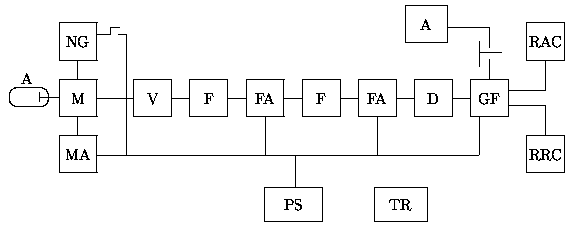
The
method of modulation is used in the radiometer.
It consists in the following: the noise signal received from the Sun
through the antenna applies to the modulator where it is modulated at a
frequency of 100Hz. The modulated signal passes through the high frequency
filter tuned in a frequency of 210 MHz with the passband of 2MHZ . Further, a
square-low detector is located on the path of the high-frequency modulated
signal being detected. At last a low-frequency signal of 1000Hz emerges. The
signal enters into the heterodyne filter, here it is amplified by means of a
low-frequency amplifier with maximum antenna gain 1000 times. It can be changed
using the control knobs on the facade panel of the receiver. The amplified
low-frequency signal enters into a synchronous filter transmitting the signal
of the frequency, by which the high-frequency radio signal is modulated.
Further, the signal in the same heterodyne filter is transformed into constant
current, which is registered with a recorder.
The
radiometer is provided with a rough channel switching in case the signal of a
certain value is amplified. On the recorder this signal is determined as 0.9 of
the scale. The signal is brought into the rough channel from quadratic
detector. Maximum enhancement of the rough channel is 100 times less than that
of the accurate one. The rough channel is switched by the automatic unit at
closing the relay contacts connecting the recorder to the power supply of 220
V. The rough channel is disconnected by pressing the button on the facade panel
of the radiometer.
A
noise generator is installed in the radiometer, from which the signal passes to
the modulator by means of the toggle switch on the receiver facade panel.
All
the units of the receiver are supplied with the power from a stabilised source
of supply ±12,6 V. which is located in the radiometer.
The
whole receiver is heat settled. The inside temperature is kept 350C by means of
a thermostabilizing unit operating from 220 V alternating current power
supply. Unit Diagram of the Radiometer
At 210 MHz
A -
antenna of the radio telescope
M -
modulator
NG -
semi-conductor noise generator
MA -
modulation signal amplifier
V -
valve
FA -
high frequency amplifier
F -
high frequency filter
D -
quadratic detector
Gf -
generator filter
PS -
power supply unit
A -
automatic equipment for switching the
rough channel
TR -
thermoregulator
RAC -
recorder of the accurate channel
RRC-
recorder of the rough channel
The
value of internal noises is no more than 0.01 of the signal from the
"quiescent Sun". When the solar radio emission is registered the
galaxy background is excluded.
Relative
celebration of the receiver is performed by the noise generator on the diode at
the beginning and end of each observation. Absolute calibration is done by
comparison of the signal at the receiver output from the calibration noise
generator and the source of Cassiopeia A approximately once a year (duration of
observation is 4-6 hours a day).
The
catalogue covers a cycle of the solar radio emission within 1957-1967. It
embodies separate sections of continuous record of the total flux of the solar
radio emission corresponding with those time intervals, when the bursts of the
solar emission, refered to as unusual phenomena in the radio band, were
registered. Out of a considerable number of the registered events, the unusual
phenomena distinctly standing out against the background of total solar
activity of a suitable day, were selected for the catalogue. Bursts, sets of
bursts as well as noise storms are reckoned among such phenomena. In case a
certain day of the solar radiation could be, on the whole, characterised as a
quiescent one, but if, on this background there was a group of bursts lasting
more than a minute with the intensity of the "quiescent" Sun level,
such a group was included in the catalogue. If there was a noise storm during
the whole observational time, not all the bursts were included, but only the
sections of the noise storm, somehow standing out against the background of
total activity. Accordingly, about 900 unusual phenomena have beer processed.
Occasionally
at registering of a large solar radiation burst, many times exceeding the level
of the "quiescent" Sun,
sensitivity of the radiometer varied repeatedly. The records were copied at a
special laboratory.
All
the bursts of the solar radio emission are represented in the coordinates of
intensity-time. The intensity in the units of 10-22W M-2Hz-1
and Greenwich time (VT) are plotted along the axis of ordinates and that of
abscissas, respectively. The level of the receiver internal noise coincides
with the time axis.
In the catalogue all the records are arranged in chronological order. Each record has an ordinal number. Additional data on the events are listed in the table 1. It contains the ordinal number of the record, date, time interval, beginning and end, type of phenomenon and intensity flux. As it is seem about 1/3 of the events in the solar radio emission occurred in the periods when there were no chromosphere flares. In most cases this can be explained by the fact that single bursts and short-lived groups of bursts often occur both during subflares and other active processes on the Sun (such as short-lived brightening of a flocculus and fast movement of fibres in the magnetic fields of spots), and also that in some periods of registration of the solar radio emission there could be no optical observation of the bursts. Besides, the solar radio emission bursts can be registered during the flares beyond the limb which cannot be observed by optical methods.
References
1. Quarterly Bulletin of Solar Activity, 1957 year N
119, 120, 1958 year N 121, 122, 123,124. 1959 year N 125.
2. Bulletin "Solnechnie Dannie" 1957 year N
1-12, 1958 year N 1-12, 1959 year N1-12
3. Moiseev I.G. Proceedings of Crimea Astrophysical
Observatory 1955, 15, 104
4. Moiseev I.G., Yurobckaja L.I., Yurovski Yu.F.
Proceedings of Crimea Astrophysical Observatory 1969, 39, 325
5. Makandarashvili Sh.S. Bulletin of Abastumani
Astrophysical Observatory 1962 year, N 29
6. Alimbarashvili A.N., Makandarashvili Sh.S.,
Parsadanova E.I. Bulletin of
Abastumani Astrophysical Observatory 1962 year, N 29
|
|
|
/24-10-58.JPG) |
/15-07-59a.JPG) |
/15-07-59b.JPG) |
/16-10-59.JPG) |
/3-02-60.JPG) |
/31-03-60b.JPG) |
/2-07-60.JPG) |
/23-03-61.JPG) |
/30-04-61.JPG) |
/25-06-62.JPG) |
/18-04-63.JPG) |
/10-09-65a.JPG) |
/10-09-65b.JPG) |
/29-03-66.JPG) |
/27-12-57.JPG)
/18-09-58.JPG)